How Lufthansa Technik is establishing a new meeting culture
Many of the 4,500 employees in Lufthansa Technik’s Aircraft Component Services segment were stuck in working days full of endless meeting loops. An internal community of facilitators aims to change this with the help of 9 Spaces and establish a new meeting culture.
Lufthansa Technik is one of the world’s leading companies in aircraft maintenance, repair and overhaul. The company is headquartered in Hamburg and employs more than 24,000 people worldwide. Aircraft Component Services (ACS) is one of Lufthansa Technik’s five business segments.
- Industry: Aerospace (MRO – maintenance, repair and overhaul)
- Headquarters: Hamburg, Germany
- Number of employees: 24.114
- Employees in this segment: 4.500
The challenge
“Nose-to-tail” is a term from aircraft maintenance that describes how one aircraft after another is moved into the hangar for servicing. One aircraft leaves, the next one enters – nose lined up with tail.
Janne Weidisch, Transformation Manager in the Aircraft Component Services segment at Lufthansa Technik, uses this image to illustrate the overcrowded calendars in the organisation: “Many calendars show working days or even entire weeks with nose-to-tail sequences of appointments – especially those of administrative roles and the leadership team.”
This means one meeting follows the next. Time for focused and creative work becomes scarce and has to be fought for. To be successful in the long run, organisations need a good balance of meetings that create clarity and energy, meeting-free time for focused individual work, and creative space where things can emerge without an agenda. Janne’s initial questions were therefore:
- How can we succeed in optimising the huge number of meetings in our segment with 4,500 employees?
- How do we get our entire organisation ready to become better in every meeting than in the one before and to create meeting-free time in our calendars?
The solution: a community of facilitators
Good meetings are facilitated.
This was one of several agreements on good meetings that the management team of the business segment made very early in the change process. This was followed by the establishment of an internal community of facilitators, made up of colleagues who volunteered to make a significant contribution to better meetings alongside their main role. The community was founded in Hamburg in the summer of 2023 and aims to sustainably improve the quality and efficiency of meetings and workshops. Today, more than 50 employees are active members of the community.
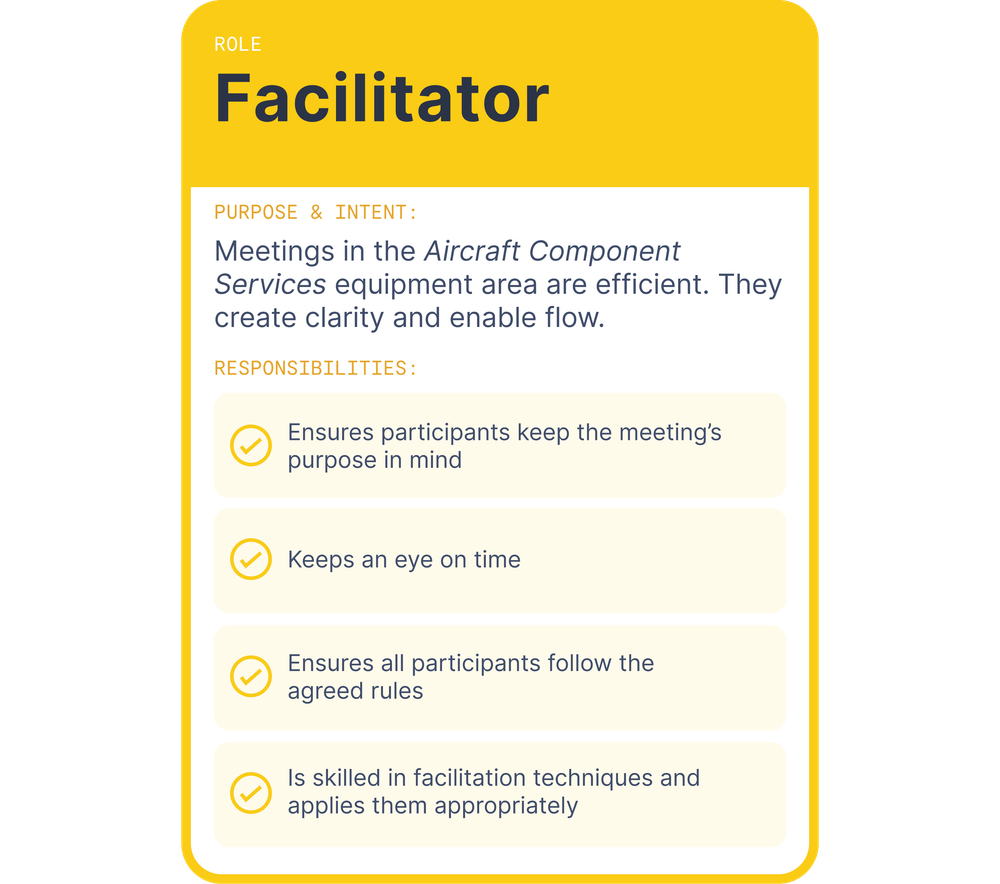
Using the template from the 9 Spaces tool “Role Profiles”, the community defined roles with clear responsibilities. Each role consists of a purpose (“Why do we need this role? What is its unattainable goal?”) and several responsibilities. The facilitator role is defined as follows:
Purpose: Meetings in the Aircraft Component Services segment are efficient. They create clarity and enable flow.
Responsibilities:
- ensures that all participants know and keep the meeting’s purpose in mind
- keeps an eye on time
- ensures that all participants follow the rules
- is familiar with facilitation techniques and applies them effectively
“The facilitator community is a huge asset for our segment,” says Daniel Gross, Head of Asset Management & Fulfilment. “Even if it sometimes feels painful to allocate capacity to the community that is also urgently needed for operational topics, the investment pays off. Good facilitation helps us achieve strong workshop results quickly and efficiently. In addition, the community fosters a culture of giving and taking. Our facilitator colleagues truly thrive when they’re able to fully contribute their strengths.”
Five particularly active facilitators have access to the Team plan licence of the 9 Spaces tool platform and use it to design and prepare workshops and meetings. Within the community, these five take on senior roles. One of the responsibilities of this role is to support less experienced facilitators in shaping their purpose and to share knowledge with them.
Employees who need a facilitator can reach out to the facilitators via an internal community channel in Microsoft Teams. Janne explains: “Designing our workshops always starts with a briefing conversation between the facilitator and the client to clarify purpose, goals, wishes and any other framework conditions we should consider.”
Once purpose and goals are clear, facilitators use the 9 Spaces tool platform to identify suitable structures and exercises and prepare the workshop or meeting.
“We either search by keywords or explore the predefined categories. We’ve also worked with the journeys and designed more complex learning journeys made up of multiple formats”, Janne says.
Voices from Lufthansa Technik
One thing is clear: the community is a movement from within. It's not just full-time moderation professionals, but also committed and motivated career changers who receive three four-hour training sessions and then continue learning with the community. Giving these employees confidence and teaching them new formats in a light-hearted way is an important added value of 9 Spaces. "I particularly like the combination of explanatory videos and PDF files. They enable even less experienced colleagues to apply methods and tools. I like to watch the video to get started and gain a great basic understanding. In my own preparation, I then follow the instructions in the PDF handout," says Janne.
A new meeting culture cannot be decided upon or implemented in a closed transformation project. It requires constant impetus and continuous improvement. For Lufthansa Technik, the facilitator community is a pragmatic way to improve its own meetings across the board in small but steady steps.

Book a call with our team
Let’s talk about how your team or organisation can unlock the full potential of 9 Spaces with real examples from other organisations.